Tom Hunter, Natasha Wunsch and Marie-Eve Bélanger argue that Russia’s war has exposed the double-edged nature of European discourse. The EU has long sustained itself through words; now language has become strategy, shaping what is politically possible. For the EU to endure, this rhetorical power must become institutional commitment
When words become strategic, they bind as much as they inspire. Russia’s full-scale invasion of Ukraine led to a general reinvigoration of enlargement discourse, and shifted enlargement debates into geopolitical terrain. Enlargement thus emerges as a moral obligation, anchored in the logic of consistency across Europe’s candidate states, as Maryna Rabinovych, Marius Ghincea and Laurențiu Pleșca argue in this series. Yet this rhetorical momentum, powerful as it is, remains precarious until the EU can translate it into concrete commitments.
Russia’s full-scale invasion of Ukraine in February 2022 didn't just redraw Europe’s security map. It also transformed the framing of enlargement in EU debates. Brussels had long treated enlargement as a technical matter, based on conditionality. Russia’s war recast it as a principle of European construction: expressions of solidarity with Ukraine turned into a discourse about the EU itself. This shift is particularly visible in the European Parliament.
Brussels had long treated enlargement as a technical matter, based on conditionality. Russia’s war recast it as a principle of European construction
Inside the European Parliament, our recent research identifies a geopolitical turning point after February 2022 in how policymakers have framed Ukraine’s EU accession path. Solidarity, expressed as a moral obligation, grounds enlargement in the Union’s founding values, and gives it a binding quality. Consistency in applying principles is central to the European project. This logic therefore extends beyond Ukraine to other candidate states, albeit unevenly.
We analysed more than 1,700 hand-coded enlargement statements in European Parliament debates from 2019–2024. Our results show that rhetorical entrapment primarily affects pro-European MEPs already inclined toward enlargement. These actors extend their logic outward in concentric circles: strongest for Moldova and Georgia, resonant for the Western Balkans, weakest for Turkey:
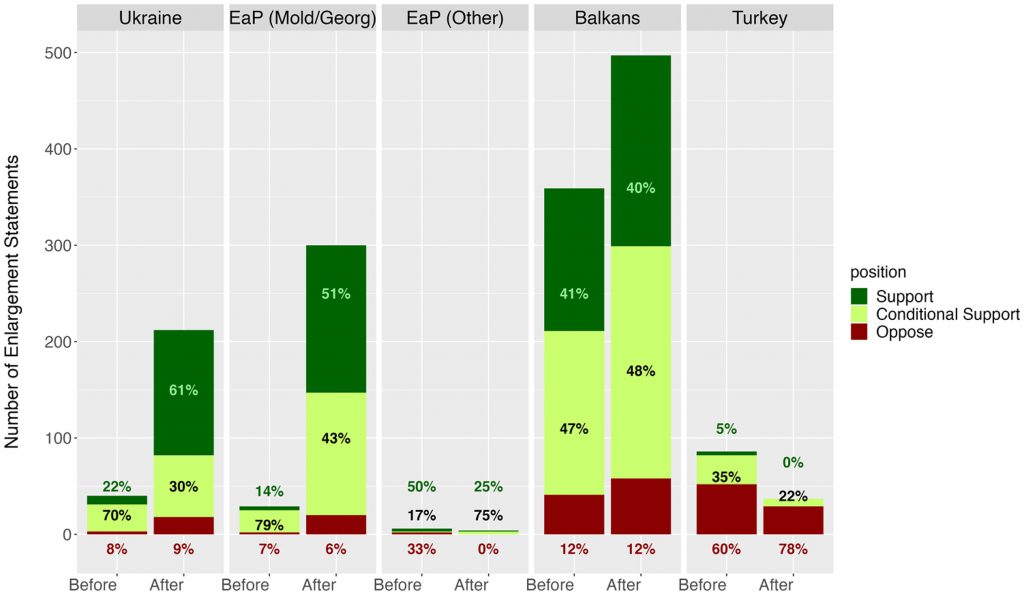
Rather than converting sceptics, the war magnifies existing commitments. Debates on Ukraine’s candidacy reverberate across neighbouring cases, expanding enlargement discourse in frequency and breadth. Support for Moldova and Georgia grows markedly, while discussions of Turkey decline. Ukraine becomes a rhetorical pivot, a catalyst that intensifies support among allies without changing opponents’ minds.
Radical parties on the left and right largely resist this logic, choosing avoidance over entrapment. As public support for Ukraine consolidated, they stopped engaging with the issue altogether, staying rhetorically consistent but increasingly marginal in parliamentary debate.
A closer look at radical party groups’ enlargement statements illuminates how this strategy of avoidance unfolds. In the immediate months after the invasion, it is noticeable how radical-right representatives still urged caution over granting Ukraine candidate status. As pro-Ukraine public opinion and geopolitics became consolidated, however, these parties stopped talking about Ukraine altogether. Indeed, after June 2022, Identity and Democracy MEPs have made only eight references to Ukraine (fewer than any other party family), despite having organised several plenary debates on the country.
For Central and Eastern European member states, Ukraine’s candidacy is part of a wider regional story which includes Moldova, Georgia, and the Western Balkans
By contrast, representatives from Central and Eastern Europe are seizing the moment. Drawing on their own recent accession experiences, they push the logic of consistency to its fullest. For them, Ukraine’s candidacy is not an isolated case but part of a wider regional story in which Moldova, Georgia, and the Western Balkans must be included. In this framing, the EU’s credibility depends on following through. To champion Ukraine while neglecting its neighbours would expose the EU to charges of hypocrisy.
The result is a differentiated landscape. The rhetorical 'trap' does not convert sceptics, but it does deepen commitments among those already inclined to support enlargement. It equips mainstream parties with stronger arguments, amplifies voices from Central and Eastern Europe, and re-centres enlargement within the EU’s strategic vocabulary. Yet this alignment remains precarious. Rhetoric can open political space, but if not anchored in concrete institutional steps, it risks hardening into frustration among candidate countries, and creating hesitance within the Union itself.
This pattern of rhetorical entrapment underscores a larger tension between words and policy decisions. Enlargement requires institutional adaptation, financial redistribution, and political will beyond the European Parliament. The very words that have reinvigorated enlargement could become empty gestures if not anchored in credible action.
Decisive action by the EU could mark the beginning of a renewed enlargement era, reshaping borders in response to the greatest security challenges of its time
What this moment reveals is the double-edged nature of European discourse. The EU has always been a polity built through words: treaties, declarations, speeches, and symbolic acts that construct its legitimacy. But the war in Ukraine shows that language can itself become strategy: not just describing Europe’s commitments but shaping the field of what is politically possible. That power, however, is not self-sustaining. To endure, it must translate into institutional decisions and material commitments.
Europe thus stands before a familiar paradox. Its rhetoric has created an opening that many thought closed, aligning moral principle with geopolitical necessity. Yet the window is narrow and fragile. If the Union acts decisively, it could mark the beginning of a renewed enlargement era, one that reshapes Europe’s borders in response to one of the greatest security challenges of its time. If not, words of solidarity may become a mere mirror of Europe’s hesitations, echoing in the corridors of Brussels without consequence.
The future of enlargement will depend on whether Europe can do what its words already claim: to extend solidarity not as a gesture, but as a commitment.