
A growing share of Western European electorates holds a set of ideological positions to which only liberal parties can adequately cater, argues Alexander Davenport. While this has yet to bring increased success for most parties, the potential remains for them to reshape politics in the region
As Karl Pike's recent insightful piece pointed out, ideological centrism 'has long been an ambiguous political term within liberal democracies'. Historically, this presented liberal parties, often synonymous with the idea of the centre ground, with difficulties in appealing to voters.
People like to know what they are voting for. As a result, most have tended to prefer parties of the traditional left or right, whose ideologies they see as more tangible than these 'centrist' liberals.
In my view, however, liberal parties’ association with the centre is not entirely deserved. In general, these parties maintain distinctively liberal preferences for (at most) limited state intervention in citizens' private lives and economic activity. The problem for liberals is that this set of positions does not align clearly with either side of the left-right dimension that has long been the predominant understanding of political ideology.
Most liberal parties believe in limited state intervention in citizens' private lives and economic activity, but this doesn't align with either side of the predominant left-right understanding of ideology
Opposing excessive state intervention in the economy is associated with the free-market right. Supporting individuals’ freedom to do as they wish in their personal lives is a policy of the cosmopolitan, progressive left. If we take them together in left-right terms, then, these positions add up to an unattractively ambiguous neither-left-nor-right stance.
Of course, the idea of a single left-right ideological dimension was always a major simplification. And much recent evidence suggests it has become far less useful in mapping voters’ political preferences. Many of the political and economic factors influencing voter ideology have changed since the mid-twentieth century. Traditional industry, for example, has declined, and access to higher education has expanded.
It is therefore less common for voters to align consistently with the ‘left’ or ‘right’ across different issues. Many researchers now take this ideological shift into account. Consequently, they now separate voters’ attitudes towards economic (ie state versus market) and cultural (ie nationalist/conservative versus cosmopolitan/progressive) issues when identifying their ideological positions.
As my new book argues, it is this shift in political ideology that, in theory, presents liberal parties with a great opportunity. Among the voters who no longer conform to the left or right across issues, a growing number – typically young, highly educated professionals with well-paying jobs – combine a preference for free-market economic policy with cosmopolitan cultural positions such as positive views of immigration and the EU. I find that this combination of right-leaning stances on economics and left-leaning stances on culture is now about as common among voters as holding consistently left-wing or right-wing positions across issues.
A growing number of voters combine a preference for free-market economic policy with cosmopolitan cultural positions, presenting liberal parties with an attractive opportunity
Crucially, this ‘market cosmopolitan’ positioning aligns very well with liberal ideology. In fact, among the major political parties these positions appear unique to liberals. According to expert survey data, most other parties hold positions more consistent with the traditional left or right. Some liberals also lean towards the traditional right-wing stances of conservative parties. Yet the majority, whom I term ‘social liberals’, represent the only major Western European parties to occupy this market cosmopolitan space (the bottom-right quadrant of each of these plots). Not only are they an excellent match for the voters in this space, but they should face little direct competition from rivals.
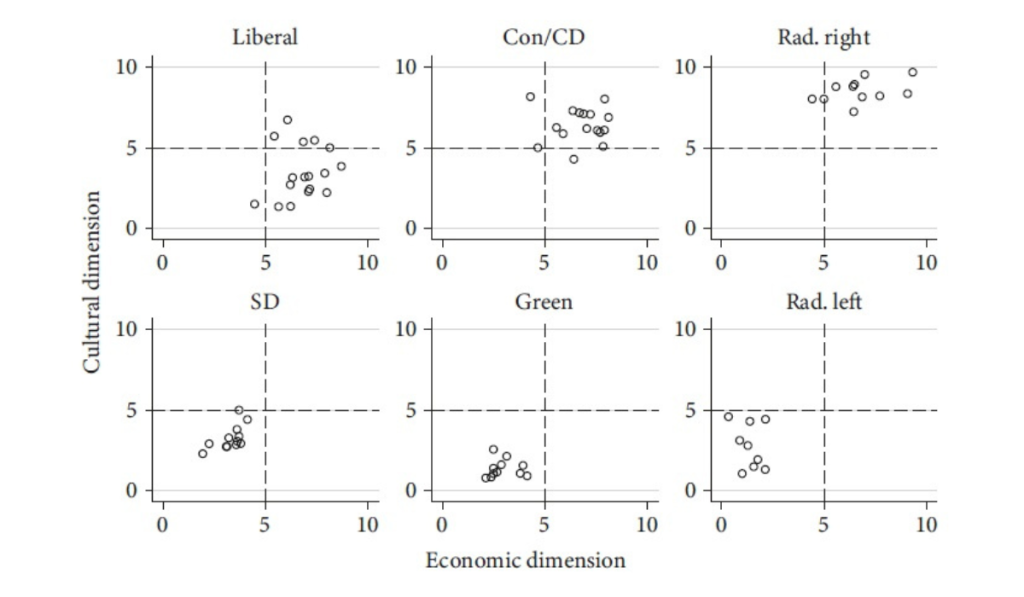
So, there are promising signs of electoral opportunity for social liberals. However, there is little evidence that social liberals are winning more support in practice. Aside from the success of Emmanuel Macron’s political movement in 2017, social liberals have tended not to increase their support in any substantial or prolonged way. Examining the vote choices of these market cosmopolitan voters shows not only that very few support social liberal parties. Instead, they favour a range of less ideologically compatible alternatives.
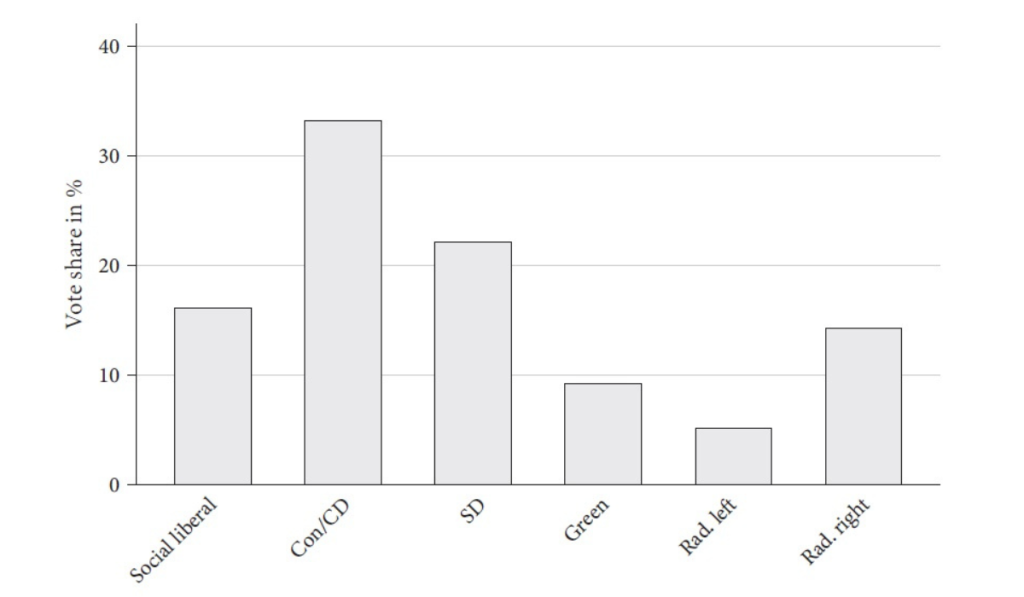
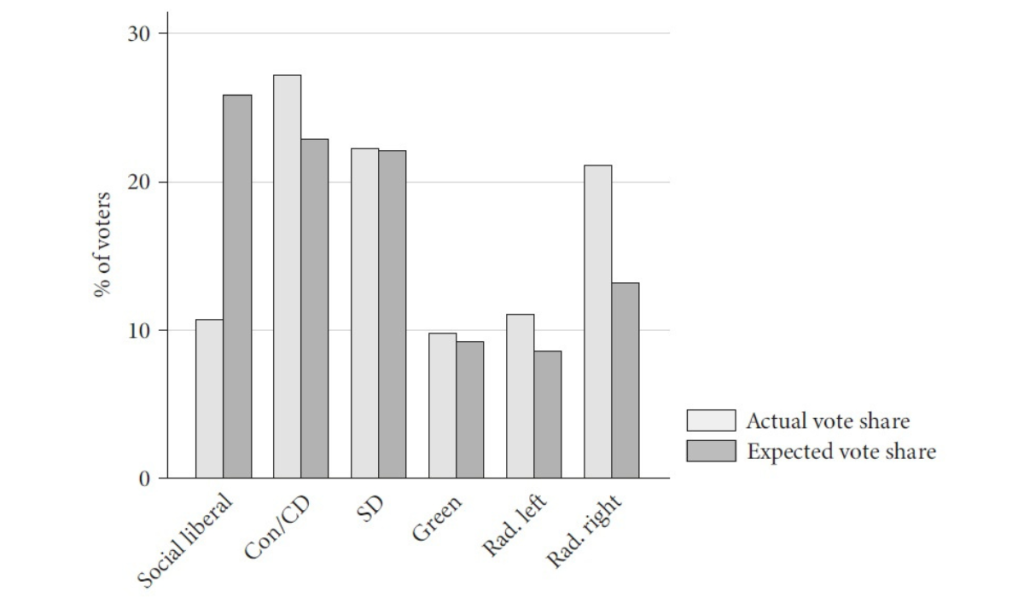
Among market cosmopolitan voters, social liberals lag well behind conservative and social democratic parties. Indeed, they only win similar levels of support to radical-right parties. This leads to a striking disparity between the proportion of voters to whom social liberals are ideologically proximate (as represented by their ‘expected’ vote share in the below graph) and the support they win in practice. On this evidence, social liberals are Western Europe’s great underachievers.
What explains this apparent missed opportunity? Firstly, social liberals lack positive reputations among voters for non-ideological matters such as integrity and governing competence. Such parties have often served as junior partners in coalition governments. This of course means they are likely to compromise on many of their campaign promises when entering government. Voters may well then blame them at the ballot box for passing unpopular policies and reneging on their earlier commitments.
Perhaps more importantly, many market cosmopolitan voters have developed strong partisan ties – which likely pre-date their current ideological positioning – to other, typically conservative and social democratic parties. These ties have endured over the long term, and are difficult to shake. As a result, many such voters continue to overlook social liberals, despite their ideological compatibility.
Social liberals’ electoral potential remains unfulfilled. This does not mean, however, that the opportunity has passed them by entirely. As long as large numbers of the electorate hold market cosmopolitan attitudes, and social liberals exclusively share these positions, the possibility of converting these like-minded voters into supporters will remain.
If social liberals stay true to their cultural cosmopolitanism, they may appeal to voters who feel alienated by their current parties’ nationalistic shifts
To challenge the radical right, many major parties have toughened their stances on issues like immigration. If social liberals stay true to their cultural cosmopolitanism, they may be able to appeal to voters who feel alienated by their current parties’ nationalistic shifts.
In fact, there are some signs that these parties are heading in the right direction. One clear demonstration was the recent electoral breakthrough in the Netherlands by the social liberal D66. While the success of liberal parties is far from guaranteed, then, we should not underestimate the potential appeal of this distinctively liberal policy platform among voters in Western Europe.


Alexander earned his PhD in political science at the European University Institute.
His research focuses on voter preferences and political behaviour.

The Unfulfilled Electoral Potential of West European Liberal Parties
Oxford University Press, 2026


