Jelena Džankić
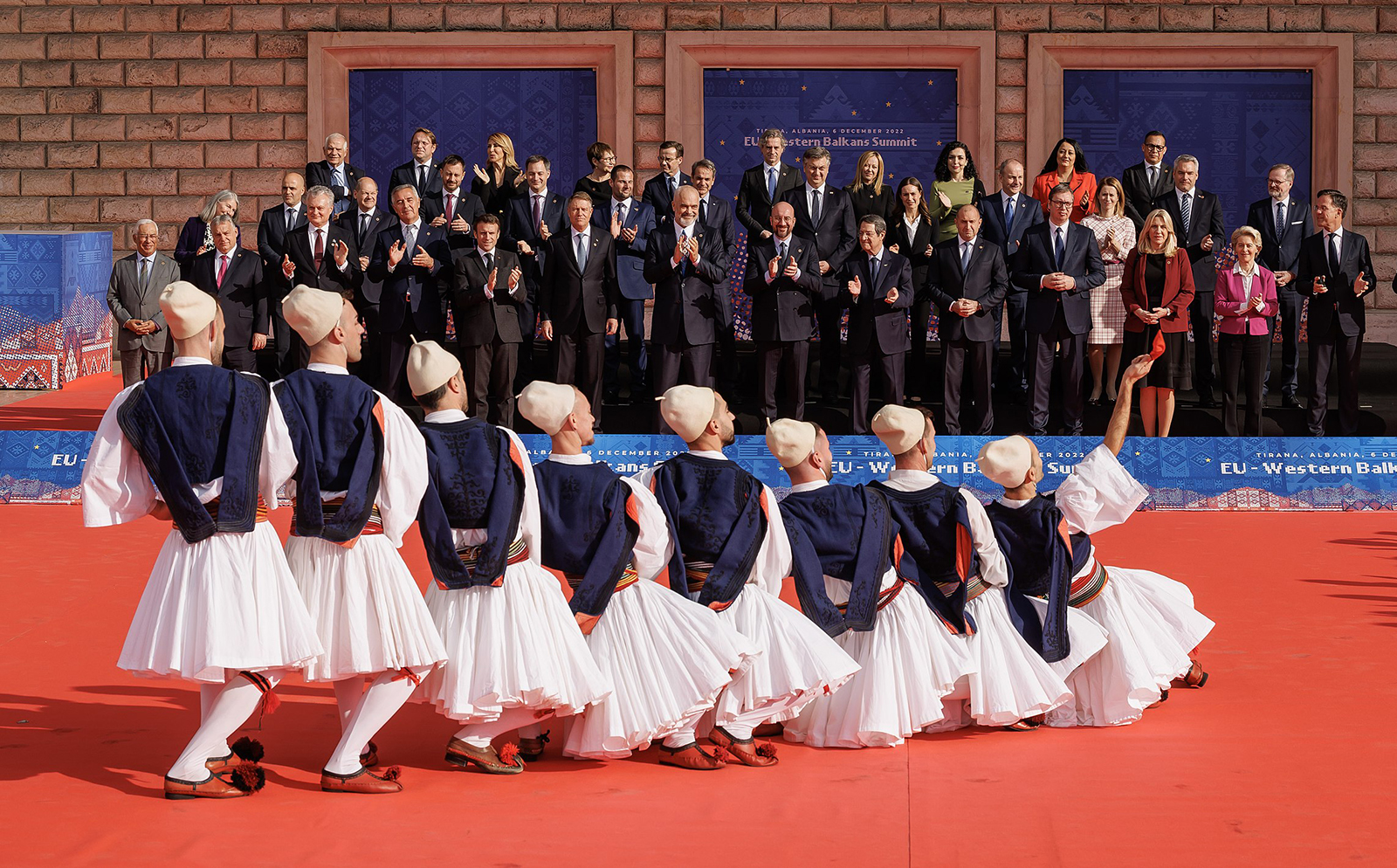
The EU enlargement process successfully transformed Southern and Eastern European states into market democracies, but faltered in the Western Balkans. Jelena Džankić argues that amid today’s geopolitical challenges, prioritising the transformative mechanisms of EU enlargement is more critical than focusing solely on achieving full membership Read more
Maria Giulia Amadio Viceré
EU enlargement could address collective action problems and stabilise its neighbourhood, but stalled accession processes may make full membership unlikely. Maria Giulia Amadio Viceré and Matteo Bonomi suggest that partial integration — engaging candidate countries in EU policies without membership — will remain the EU's main strategy for managing internal and regional crises Read more
Francesco Foti
The West is failing to invest against Russian encroachment in Georgia, choosing instead to break relations. Francesco Foti argues that Western disengagement will prove a serious obstacle to Georgia realigning with the West. Read more
John Chin
Georgia is undergoing its most significant mass uprising since the 2003 rose revolution, with the future of democracy in Georgia and Georgia’s future in Europe at stake. John Chin and Anastasia Kim put this unrest in context by reviewing Georgia’s revolutionary history and ongoing challenges posed by Russian sharp power Read more
Frank Schimmelfennig
The EU is caught in a dilemma between its geopolitical urge to enlarge and the high institutional standards for membership. Frank Schimmelfennig argues that differentiated integration would help square the circle. Committed candidate countries could join fast, but only enjoy full rights and benefits of membership conditional on institutional progress Read more
Veronica Anghel
Launching her series on EU enlargement dilemmas, Veronica Anghel argues that enlargement is no gamble, but a strategic necessity. In crisis, enlargement transforms external risks into shared responsibilities, reinforcing governance, security, and global influence — and ensuring the Union’s survival and relevance Read more
Andreea Tănasie
Memory is a buzzword in many political and cultural debates, for building a shared identity to legitimising right-wing populism. Andreea Tănasie explores the institutionalisation of memory through museums across Europe, revealing how curatorial choices hide broader dynamics of legitimacy and exclusion Read more
Laura Sudulich
Women are not a demographic minority, but they are certainly still a minority in politics. Laura Sudulich, Siim Trumm, and Iakovos Makropoulos show that a significant gender resource gap continues to be a feature of contemporary parliamentary campaigns. Women face an uphill battle to get elected Read more
We use necessary cookies to make our site work. We'd also like to set analytics cookies that help us make improvements by measuring how you use the site. These will be set only if you accept.
▼
Strictly Necessary Cookies
Necessary cookies enable core functionality such as security, network management, and accessibility. You may disable these by changing your browser settings, but this may affect how the website functions.
▼
Analytics Cookies
Google Analytics
We'd like to set Google Analytics cookies to help us improve our website by collecting and reporting information on how you use it. The cookies collect information in a way that does not directly identify anyone. For more information on how these cookies work please see our Privacy Notice.