The new Mayor of New York’s electoral campaign prioritised face-to-face interactions with voters. Western commentators have struggled to find a language for this new ‘politics of listening’. Portia Roelofs argues that this is a standard part of Nigerian political practice – and offers the potential for a new kind of accountability
The newly elected democratic mayor of New York City, Zohran Mamdani, made unscripted face-to-face interactions with members of the public a key part of his campaign strategy. This led the New York Times to describe him as having 'a rare talent for listening'. Yet commentators have struggled to put their finger on quite what is going on in these interactions. That Mamdani's face-to-face approach seems so radical and yet intuitively democratic should give us pause to think. Have our dominant theories of democracy missed a trick?
In fact, if we look beyond the West, what Mamdani is doing is pretty de rigeur. It even has a name: accessibility. Nigerians have long treated these sort of interactions as an essential component of democratic practice. Direct interactions between rulers and the ruled fall under the broad principle of ‘accessibility’. Voters and politicians alike value them as part of how the electorate keeps politicians on the straight and narrow.
In Nigeria, voters and politicians alike value direct interaction for keeping representatives on the straight and narrow
As my ethnographic research on politics in south-west Nigeria shows, politicians and local leaders maintain accessibility by attending public events, walking the streets of their constituency, and maintaining a local office. You might assume that face-to-face interaction would be limited to small-scale politics. In Nigeria, however, ‘local’ is interpreted broadly. Ibadan, the focus of my research, is a city of at least three million people. New York hovers somewhere above eight million.
Indeed, in Nigeria’s 2023 presidential election – with upwards of 90 million eligible voters – being accessible was central to the appeal of outsider third-party candidate Peter Obi. Videos of Obi travelling without an entourage and chatting with fellow passengers circulated as evidence of his ‘accessibility’. Similarly, videos of Mamdani walking the streets of New York talking to voters went viral. All this has prompted debate about what exactly is so valued and valuable about face-to-face interaction.
Some commentators have emphasised the way that street conversations enabled Mamdani’s team to develop better quality policy proposals. Writing in The Wire, LSE’s Yasemin Giritli İnceoğlu argues that Mamdani’s politics of listening allows 'meaningful political decisions [to] arise from informed, interactive deliberation among citizens rather than from top-down messaging'. Daniel Hutton Ferris from the University of Newcastle argues in The Conversation that Mamdani’s 'deliberative political style' echoes the goals of deliberative democracy, leading to more politics which is at once more consensual without being centrist.
That could be true, but there may also be something more straightforward going on. Mamdani himself articulated this when he explained, mid-walk, 'We’re outside, because New Yorkers deserve a mayor that they can see, they can hear, they can even yell at'. In a world where politicians are widely derided as out of touch, voters may value accessibility as a form of accountability. During these unscripted face-to-face interactions, the distance which normally characterises voters' relationship to leaders collapses.
During unscripted face-to-face interactions, the distance between voters and leaders collapses
At that moment, leaders are vulnerable: their dependence on their constituents for votes – but also for support, for applause, for positive regard – moves into sharp relief. Mamdani’s genius may be less about the deliberative quality of his conversations and more about the sheer courage of putting himself in a position where he could be yelled at.
Indeed, in my research, the charge of being inaccessible was often synonymous with politicians being unaccountable. In one interview, a woman in suburban Ibadan explained that she’d repeatedly tried to call a local representative to complain about the state of local infrastructure. Time and again, aides told her the politician was 'in a meeting'. Realising she was being fobbed off, the woman smiled wryly and asked, 'Is it every day they are in a meeting?'
In my research, the charge of being inaccessible was often synonymous with politicians being unaccountable
And research suggests it isn't just Nigerians who care about accessibility. Research by Simon Coleman with British voters highlights popular disappointment with 'out-of-office' MPs. More crudely, we might think of Boris Johnson’s infamous attempt to avoid press scrutiny by hiding in a fridge as an especially sharp example of how politicians evade accountability by making themselves inaccessible.
If we think of Mamdani’s triumph as being based on accessibility, two things follow.
First, if accessibility is key to accountability, we must treat anything that threatens politicians' public safety as a serious threat to democracy. With high-profile British female MPs such as Anna Soubry facing sustained abuse, and Diane Abbott avoiding travelling around her constituency alone, this is an issue of gender equity.
Secondly, there has been growing interest in what it means to decolonise our thinking and to re-evaluate Africa's place in the world of ideas. Writers like Teju Cole, Binyavanga Wainaina and Chimamanda Ngozi Adichie have brought these questions into the mainstream, challenging western stereotypes about Africa.
In politics we can act on calls for decolonisation by ‘flipping the script’. That is, we must invert the standard story of the West as the template for democratic theory and Africa as struggling to catch up. As American politics seeks to learn the lessons from Zohran Mamdani’s rapid rise, broadening our conversation to include insights from Nigerian politics would be a great place to start.

Portia works at the intersection of African politics, political thought and critical development studies.
Her research has been published in journals such as Governance, Journal of Development Studies, African Affairs and Democratization.
Her current project explores how concepts derived from Nigerian political practice – like accessibility – shed light on the relationship between populism and democracy.
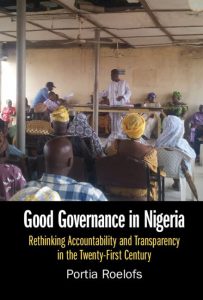
Good Governance in Nigeria: Rethinking Accountability and Transparency in the Twenty-First Century
Cambridge University Press, 2023