Global crises place extraordinary strain on international cooperation. Benjamin Faude and Kenneth W. Abbott examine how global governance performs under pressure, arguing that resilience depends on combining robust institutions with flexible arrangements, effective leadership, and the capacity to learn and adapt during crises
The world seems to lurch from one crisis to the next. Financial meltdowns, pandemics, climate emergencies, geopolitical shocks: each brings disruption, fear, and urgent calls for collective action. When these crises cross borders, as they almost always do today, they raise a fundamental question: does global governance actually work when we need it most?
This question has become especially pressing in the wake of Covid‑19. How did global institutions, from the World Health Organization to the G20, perform under the pressure of the pandemic? Our answer is nuanced, but powerful: global governance can be resilient, responding effectively to crises, but only under the right conditions.
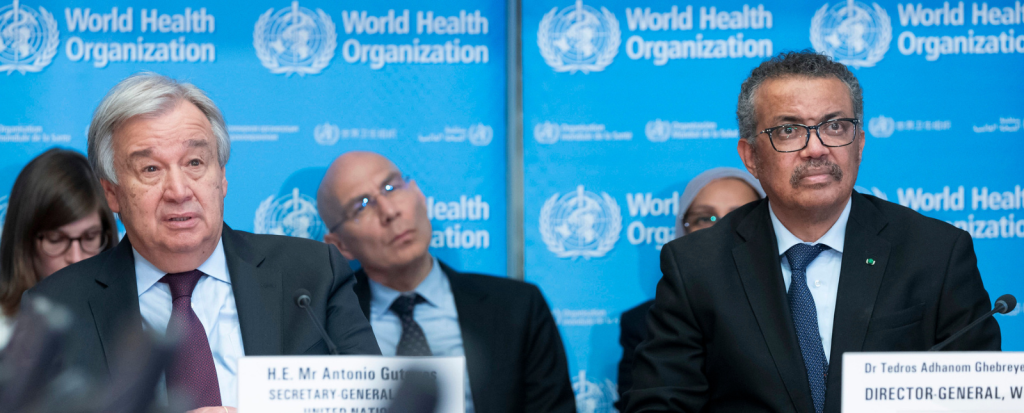
Transnational crises share three features that make cooperation extraordinarily difficult: threat, urgency, and uncertainty. The stakes are high, the need for action is immediate, and no one fully understands what is happening or what will work. These conditions push governments toward short-term thinking, unilateral action, and risk avoidance.
To assess how global governance deals with crisis conditions, we use the idea of resilience. Rather than equating resilience with mere survival or 'bouncing back', we define it as the capacity of governance institutions both to absorb stress and to adapt to it.
Absorbing stress means maintaining basic governance tasks even when incentives to defect are strong. For example, can trade rules still prevent protectionism during a financial meltdown? Can financial institutions still provide emergency support when markets panic?
A resilient system can respond to a crisis creatively, adjusting rules, creating new mechanisms, or recombining existing institutions
Adapting to stress, by contrast, is about learning, innovation, and reform. A resilient system can respond to a crisis creatively, adjusting rules, creating new mechanisms, or recombining existing institutions to better handle both the immediate crisis and future ones.
Thus, resilience is not a single trait. We distinguish three dimensions: continued performance of core functions, effective collaboration and innovation, and capacity‑building for future shocks. Together, these dimensions offer a yardstick for evaluating the crisis performance of global governance.
What determines whether global governance is resilient? We advance two key ideas. The first is structural: resilience depends on the right mix of robust and flexible institutions.
Robust institutions, typically formal intergovernmental organisations with legal rules and stable procedures, provide absorptive capacity. Because their commitments are binding and predictable, they are good at maintaining compliance and stability in turbulent times. But that same rigidity can make them slow and resistant to change.
Flexible institutions, such as informal forums, networks of national regulators, and public-private partnerships, excel at adaptive capacity. They can move quickly, experiment, and innovate. Yet their informality limits their ability to enforce commitments or prevent free‑riding.
A system tilted too far in either direction becomes fragile. Overreliance on rigid institutions can lead to paralysis; excessive dependence on flexible arrangements can produce weak coordination and shallow cooperation. Resilience emerges when robustness and flexibility are combined in a connected institutional ecosystem.
Our second key idea is that structure alone is not enough: people matter. Resilient governance depends on leaders and 'bricoleurs', actors who creatively piece together solutions from existing institutional elements.
Resilience depends on the right mix of robust and flexible institutions, and on actors who creatively piece together solutions from existing institutional elements
Leaders help frame problems, mobilise political will, and broker agreements. Bricoleurs engage in institutional improvisation. They recombine mandates, rules, and organisations to build new responses quickly, rather than waiting for formal reforms. The more diverse and denser the institutional environment, the richer the toolbox available for such innovation.
To show how our framework works in practice, we compare two landmark crises: the Global Financial Crisis and the Covid‑19 pandemic.
During the Global Financial Crisis, global governance proved remarkably resilient. Robust institutions like the International Monetary Fund and the World Trade Organization stabilised the system by providing emergency finance and discouraging protectionism. At the same time, flexible arrangements, most notably the G20 and central‑bank swap lines, enabled rapid coordination and innovation.
This balanced institutional mix allowed for creative bricolage. The G20 Leaders’ Forum emerged as a de facto global crisis committee, while regulatory reforms such as Basel III strengthened the financial system for the future. Strong political leadership amplified these effects. The result was not just crisis management, but meaningful institutional learning and reform.
During the Global Financial Crisis, global governance proved remarkably resilient. During Covid-19, however, there were far fewer robust mechanisms to ensure compliance
The Covid‑19 pandemic tells a more sobering story. Here, global responses relied heavily on flexible institutions, with far fewer robust mechanisms to ensure compliance. The World Health Organization coordinated responses, but lacked enforcement powers. Many governments pursued unilateral strategies, especially on vaccines.
Still, innovative initiatives did emerge. Partnerships involving Gavi, the Coalition for Epidemic Preparedness Innovations, and major foundations created the Access to Covid‑19 Tools Accelerator and COVAX. These were impressive feats of institutional bricolage, but their effectiveness was limited. Without strong, binding commitments from states, wealthy countries bypassed collective mechanisms, undermining equitable vaccine distribution.
The contrast between these crises highlights a central lesson: the resilience of global governance during crises depends on how its institutions are structured, combined and activated. A balanced mix of robust and flexible arrangements, embedded in a dense institutional landscape and supported by effective leadership, offers the best chance for resilience.
This insight has clear implications for current processes. Ongoing efforts to reform global health governance, such as amendments to the International Health Regulations and negotiations over a WHO pandemic agreement, are not just technical exercises. They are attempts to rebuild absorptive capacity without sacrificing adaptability.
Our framework therefore provides a way to think systematically about future crises. Instead of asking whether global governance is strong or weak in general, we should ask: does it have the right mix of stability and flexibility to absorb shocks, adapt creatively, and prepare for what comes next?