Elias Koch finds that opposition parties become more confrontational towards the government when losing in the polls, and particularly when their support drops below the previous election result. But what does this mean for political systems thriving on an antagonistic relationship between the opposition and the executive?
Conflict between the opposition and the government is a defining feature of representative democracy. By challenging the government, opposition parties scrutinise the executive and present alternative solutions to timely political challenges. This antagonism has been studied drawing on various types of opposition party behaviour such as parliamentary debating and voting behaviour.
My recent research note published in West European Politics explores whether opposition parties’ rhetoric towards the government is associated with their performance in the polls. Opposition have been shown to benefit electorally from engaging in conflict with the government. Yet, are opposition party strategies towards the government associated with their support in the polls?
Studies show that opposition parties benefit electorally from engaging in conflict with the government
Overall, parties strategically adjust their behaviour in response to losses in electoral support. When polls signal declining vote shares, mainstream parties adopt more polarised positions while niche parties tend to moderate. Polling effects also extend beyond election campaigns to legislative politics, social media strategies, and internal party dynamics, reflecting a consistent motivation to regain lost support. But do opposition parties also seek more conflict with the government when they are losing in the polls?
To address this question, I examine opposition parties’ interjections during speeches delivered by government party MPs in the 16 German state parliaments between 1998 and 2019. Interjections are a clear, flexible signal of conflict, making them well suited to study day-to-day party behaviour in a highly visible settings like parliamentary debates.
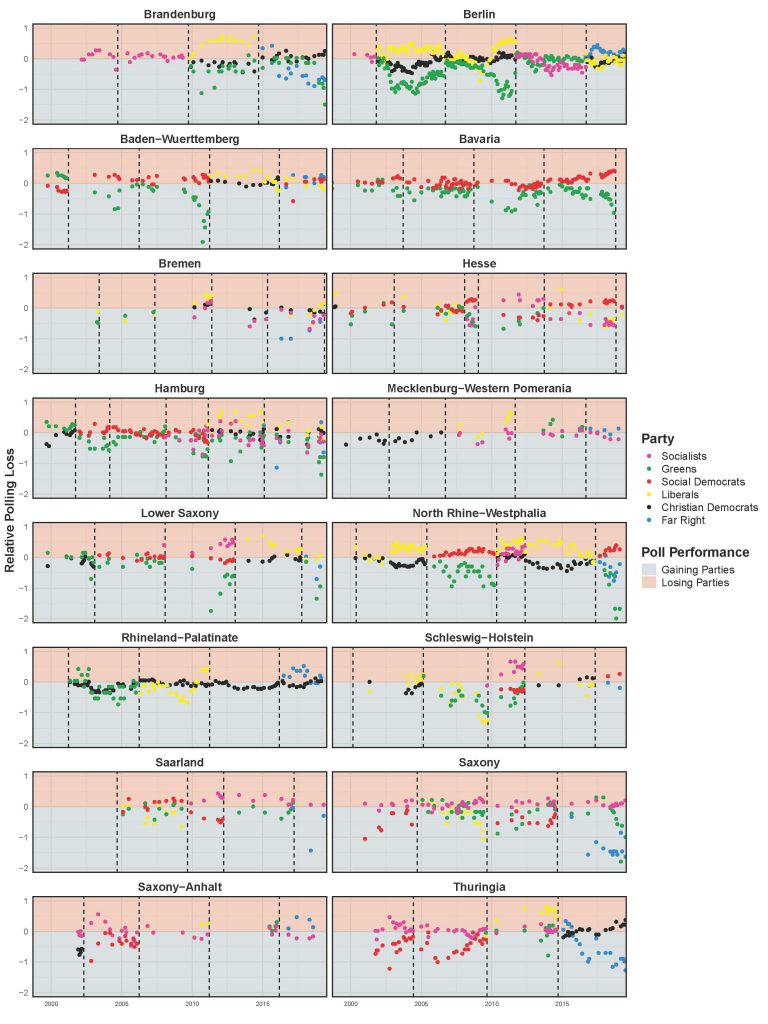
My analysis links this behaviour to changes in parties’ polling performance relative to their previous election result. The Relative Polling Loss captures whether a party is under- or outperforming its last election share. Positive values reflect losses; negative values indicate gains. As the graph shows, these patterns vary widely across parties, states, and years. At the same time, we recognise familiar patterns, like the Greens’ surge after the 2011 nuclear disaster in Fukushima and during the Fridays for Future protests, as well as the rise of the radical right in the 2010s.
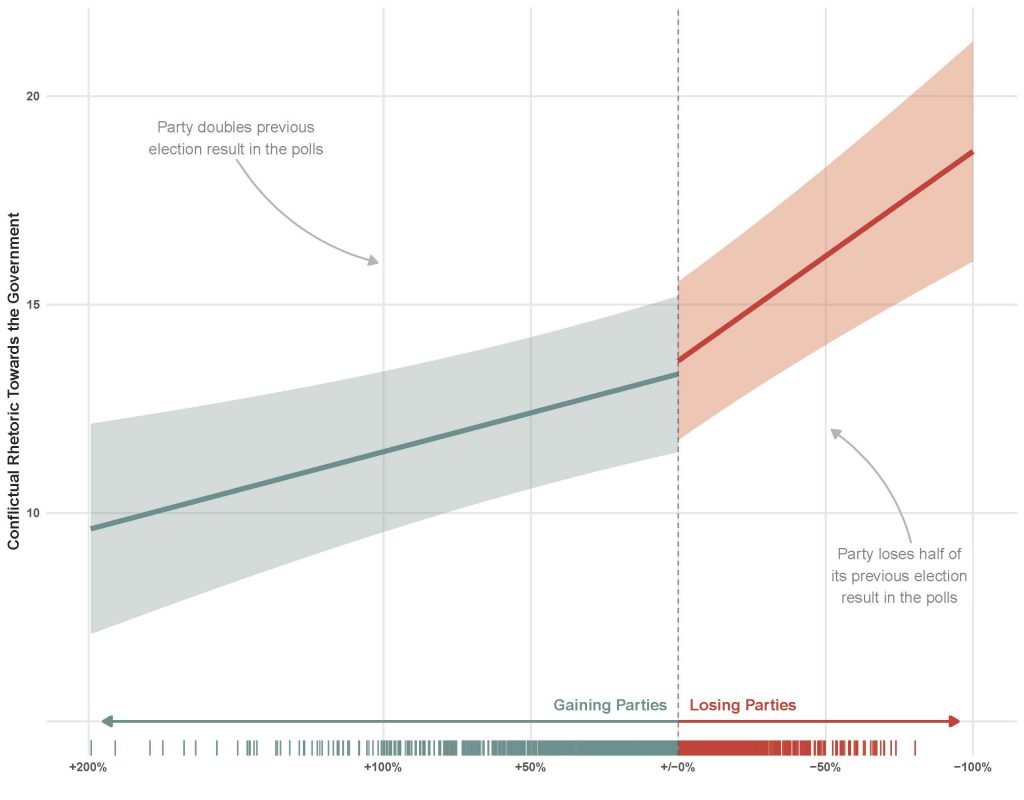
Indeed, the worse an opposition party performs in the polls, the more it engages in conflict with the government. As the graph above shows, this association is particularly evident when support for the respective opposition party drops below its previous election result. Parties on track to double their vote share make, on average, 12 interjections per 10,000 words of government speech. But when polls suggest they could lose half their seats, this number rises to about 16.
These findings carry implications for representative democracy that are encouraging, but also concerning. On the downside, it is partisan considerations, rather than substantive disagreement alone, which partly shape the degree to which opposition parties fulfil their institutional responsibility to challenge the government.
Do opposition parties have an incentive to step up their scrutiny when they lose public support? My findings suggest they do
But there’s a more optimistic perspective, too. Earlier research suggests that opposition parties have an incentive to step up their scrutiny when they lose public support. My findings indicate they actually do so.
Further, opposition parties that are rising in the polls don’t simply ease off and give the government free rein. In fact, my findings reveal that opposition parties respond far more strongly to drops in public support than to gains. While they do soften their confrontational stance somewhat when polling improves, the reduction is much smaller than the increase in conflict triggered by losses. For political systems that depend on a continuous, antagonistic engagement between opposition parties and the executive, one might also regard this asymmetry as a reassuring sign.