As Hungary heads to parliamentary elections on 12 April, Cristian Pîrvulescu argues that the billboard campaign targeting Volodymyr Zelenskyy is not merely anti-Ukrainian rhetoric. Rather, it is the latest iteration of a calculated antisemitic strategy, rooted in the 'Horthy tradition', that has powered Fidesz through four consecutive victories
The visual evidence is stark. Eight years ago, government-funded billboards across Budapest carried photographs of a smiling George Soros, captioned 'Don't let Soros have the last laugh'. Today, the same billboards carry a photograph of a similarly captioned Volodymyr Zelenskyy. The composition is identical. The smirking face, the warning, the implied threat to the nation. Only the name has changed – and in both cases the target is a Jewish figure. This is not coincidence. It is a tested electoral template.
The origins of this approach trace back to a precise political consultancy decision. In 2013, American pollster Arthur Finkelstein advised Orbán that Fidesz needed an enemy with a face — specifically, a Jewish financier with a secret agenda to destroy Hungary. The figure he chose was Soros, a Hungarian-born Holocaust survivor who had funded civil society organisations across Central Europe. Within weeks, government billboards portrayed Soros as a puppet master manipulating Hungarian politics from the shadows.
Fidesz's antisemitic strategy dates back to 2013, when the party targeted George Soros and ignored calls to remove billboards defaced with antisemitic remarks
The largest Hungarian Jewish organisation, Mazsihisz, wrote to Orbán warning that the billboards encouraged antisemitism. Several were rapidly defaced with 'stinking Jew' and 'vampire'. Orbán ignored the calls to remove them. Fidesz won the 2014 elections. And the next ones in 2018. Clearly, the template worked.
Orbán's use of antisemitic coding does not emerge from a vacuum. It draws on a tradition of historical revisionism that his government has actively cultivated. In 2017, Orbán declared interwar regent Miklós Horthy an 'exceptional statesman' — the same Horthy under whose rule Hungary passed the first antisemitic law in 20th-century Europe in 1920, and whose government deported over 400,000 Jews to Auschwitz in 1944.
The United States Holocaust Memorial Museum condemned the statement, noting that it constituted an attempt to rehabilitate the reputation of a leader who was 'a vocal antisemite and complicit in the murder of the country's Jewish population'. The Orbán government proceeded regardless. It introduced antisemitic writers into the national curriculum. It redesigned government-sponsored museums to play down Hungarian complicity in the Holocaust. The institutional infrastructure of historical denial was built, brick by brick, over 15 years.
The campaign for April's elections follows a familiar pattern, with an escalation that reflects Orbán's current electoral vulnerability. On 25 February 2026, Hungary's most reliable pollster found Fidesz trailing Tisza by 20 points among decided voters — the largest deficit the governing party has ever faced.
When Orbán discovered he was trailing in the polls, he immediately accused Ukraine of plotting attacks on Hungarian energy infrastructure, and he intensified smears against Zelenskyy
The response was immediate. Orbán accused Ukraine of plotting attacks on Hungarian energy infrastructure. He intensified government-funded billboard campaigns against Zelenskyy, and even reframed the election as a binary choice between peace and war. New billboards combined Zelenskyy's face with those of Tisza leader Péter Magyar and European Commission President Ursula von der Leyen, captioned: 'They themselves are the risk'.
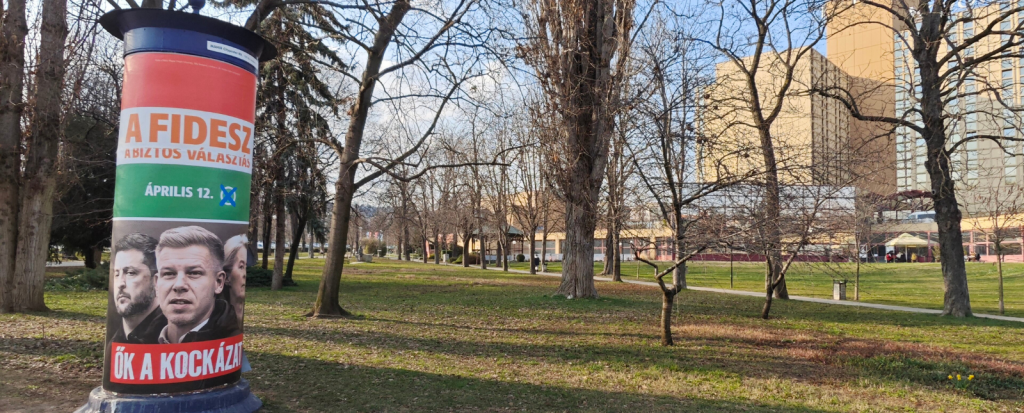
The logic is consistent with Orbán's established method. As analyst Daniel Hegedüs of the Institute for European Politics points out, Fidesz has a long history of mobilising foreign figures to create fear: 'First Brussels, then George Soros, and now Péter Magyar, all portrayed as malign alien forces conspiring to harm Hungary'. What changes between cycles is the name. What remains constant is the coding — and the face of a smiling Jew on a government billboard.
The April 2026 elections are not only a Hungarian contest. Hungary remains the only EU member state sanctioned for systemic corruption. It has consistently blocked European unity on Ukraine, sanctions and security. Can Orbán's coalition be defeated? That depends on whether antisemitic electoral mobilisation remains a viable instrument of democratic politics in Europe.
Orbán's coalition could stay in power if antisemitic electoral mobilisation remains a viable instrument of democratic politics in Europe
If it does, others will notice. The billboards will come down after election day. The strategy, refined across four electoral cycles, and the ideological infrastructure built around it, will not.
The question is whether Europe is willing to call this strategy by its name – antisemitic mobilisation – and to defeat it at the ballot box.