

Patricia is a development economist who works at the interface between Development Economics and Political Science.
She is a leading expert on political violence and development, and the co-founder and co-director of the Households in Conflict Network.
Alongside her role at UNU-WIDER, she is also Professorial Fellow at the Institute of Development Studies (IDS) in Brighton, UK (on leave).
Patricia’s research focuses on the relationship between political violence, institutional transformation, governance and development outcomes.
She has led major research programmes funded by the European Commission, the UK Economic and Social Research Council (ESRC) and the UK Department for International Development (DFID).
She is currently the director of a ESRC large grant project on the relationship between inequality, social trust and governance outcomes.
Patricia’s research has been published in leading international journals such as the Journal of Development Economics, Journal of Conflict Resolution, the Journal of Peace Research, and the World Bank Economic Review.
Patricia has held several advisory positions in major international organizations, including Action Aid, DFID, FAO, UNDP, UNESCO, UNICEF, UN Women, USAID, and the World Bank.
She was the director of the MICROCON research programme and deputy director of the TAMNEAC Initial Training Network.
Patricia holds a MPhil in Economics from the University of Cambridge and a PhD in Economics from the University of London.
She has held visiting positions at Harvard University (2007-09) and the European University Institute (2017), among others.
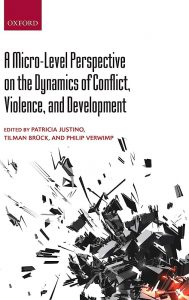
A Micro-Level Perspective on the Dynamics of Conflict, Violence and Development
Oxford University Press, 2013

