

Mark is the former director (2004–2007) of the Centre for the Study of Democratic Institutions.
He received his BA from Lewis and Clark College, and his MA and PhD from the University of Toronto.
Mark co-founded Participedia, a web platform collecting data about democratic innovation and participatory governance around the world.
Participedia is building the data infrastructure for the emerging field of democratic innovations, and serves as a resource for governments, democracy practitioners and advocates.
Mark’s research interests fall within the field of democratic theory.
He is especially interested in new forms of citizen participation and representation, the relationship between civil society and democratic governance, and the corruption of democratic relationships.
He has published extensively on these topics in various edited volumes and top journals in political science and political theory.
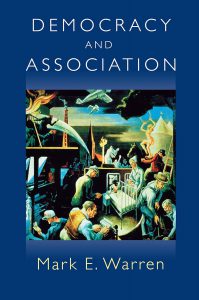
Democracy and Association
Princeton University Press, 2001
2003 winner of the Elaine and David Spitz Book Prize for Democracy and Association, awarded by the International Conference for the Study of Political Thought. Recipient of the 2003 Outstanding Book Award from the Association for Research on Nonprofit Organizations and Voluntary Action (ARNOVA)
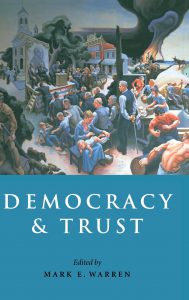
Democracy and Trust (editor)
Cambridge University Press, 1999

