

Klaudia is currently working on an international project on radical-right populism and conspiracy in four European democracies.
She obtained her PhD from Paris Lodron University of Salzburg with her dissertation titled 'Between challenges and opportunities: Western Balkans on the road to European integration – a political party perspective'.
During her PhD studies, Klaudia was a visiting researcher at the American University in Washington, DC.
Her research interests and areas of expertise encompass gender equality, EU policy, comparative and multi-level politics, and party politics.
She has also advised regional and international organisations on questions of gender equality and inclusion, integrity, and democratic governance.
Klaudia is co-editor of two forthcoming volumes, New Dynamics of Contestation in EU-Western Balkan Relations (with Doris Wydra and Klodiana Beshku, Palgrave, forthcoming June 2026) and The Radical Right and Demographic Populism (with Oscar Mazzoleni, Manchester University Press, forthcoming June 2026).
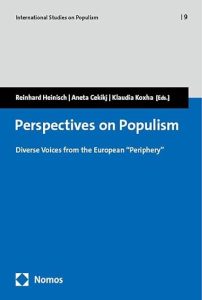
Perspectives on Populism: Diverse Voices from the European 'Periphery', edited with Reinhard Heinisch and Aneta Cekikj, Nomos Verlagsgesellschaft, 2024