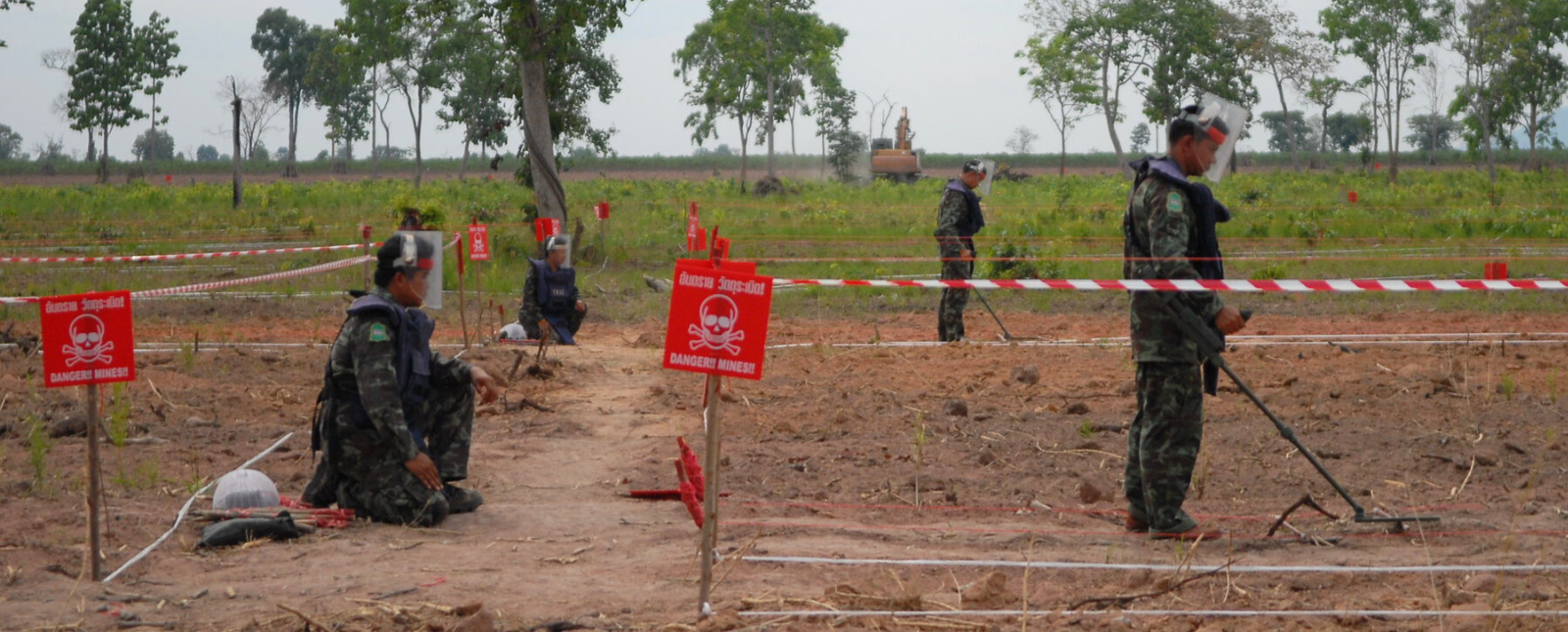
The Ottawa Convention banning anti-personnel landmines is under serious challenge. In 2025, six state parties — Poland, Lithuania, Latvia, Estonia, Finland and Ukraine — began the procedure to withdraw from the convention. Henrique Garbino and Priscyll Anctil Avoine argue for a critical assessment of the rationale behind this decision, and its consequences
PhD Candidate, Department of War Studies and Military History, Swedish Defence University
Henrique's doctoral research focuses on the use of landmines and other explosive devices by non-state armed groups.
He holds a MSSc in Peace and Conflict Studies at Uppsala University and a BSc in Military Sciences at the Military Academy of Agulhas Negras.
Prior to his current position, Henrique served in the Brazilian Army as a combat engineer officer from 2006 to 2017.
His experience in the military covered a wide range of different activities, such as explosive ordnance disposal, civil-military coordination, and training and education; in contexts as diverse as border control, law enforcement, and United Nations peace operations.
Following his military service, Henrique worked in the fields of humanitarian mine action, disarmament, demobilisation, and reintegration of former combatants (DDR), and civil-military coordination.
His work has taken him to Angola, Colombia, Gaza, Haiti, Nagorno Karabakh, Nambia, Tajikistan, and Ukraine.
Henrique continues to deploy as an explosive ordnance disposal and civil-military coordination specialist for short-term missions with the International Committee of the Red Cross and several United Nations agencies.
He is also an Associate Specialist at the Brazilian Network on Peace Operations (2021-) and an Expert at the Forum on the Arms Trade (2023-).
Henrique's research interests include civil wars, non-state armed groups, violence and restraint, mine action, peace operations, civil-military relations.
We use necessary cookies to make our site work. We'd also like to set analytics cookies that help us make improvements by measuring how you use the site. These will be set only if you accept.
▼
Strictly Necessary Cookies
Necessary cookies enable core functionality such as security, network management, and accessibility. You may disable these by changing your browser settings, but this may affect how the website functions.
▼
Analytics Cookies
Google Analytics
We'd like to set Google Analytics cookies to help us improve our website by collecting and reporting information on how you use it. The cookies collect information in a way that does not directly identify anyone. For more information on how these cookies work please see our Privacy Notice.