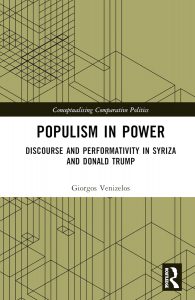

'Populism' and 'power' have an uneasy relationship. Key texts reveal three assumptions about populism's 'fate' in power: first, it becomes mainstream; second, it turns authoritarian; third, it fails/succeeds to implement policies. Giorgos Venizelos argues we must look beyond the myths about populism's content or outcomes, and turn instead to populism's function of constructing collective identities through discursive / affective performativity
Fellow in Political Polarisation, Democracy Institute, Central European University
Giorgos' research is situated at the intersections of comparative politics, political communication and contemporary political theory.
His research interests include populist/anti-populist polarisation in the age of post-truth, populism in power, collective identity and political discourse.
He has published in journals including Political Studies, Critical Sociology, Constellations and Representation.
We use necessary cookies to make our site work. We'd also like to set analytics cookies that help us make improvements by measuring how you use the site. These will be set only if you accept.
▼
Strictly Necessary Cookies
Necessary cookies enable core functionality such as security, network management, and accessibility. You may disable these by changing your browser settings, but this may affect how the website functions.
▼
Analytics Cookies
Google Analytics
We'd like to set Google Analytics cookies to help us improve our website by collecting and reporting information on how you use it. The cookies collect information in a way that does not directly identify anyone. For more information on how these cookies work please see our Privacy Notice.