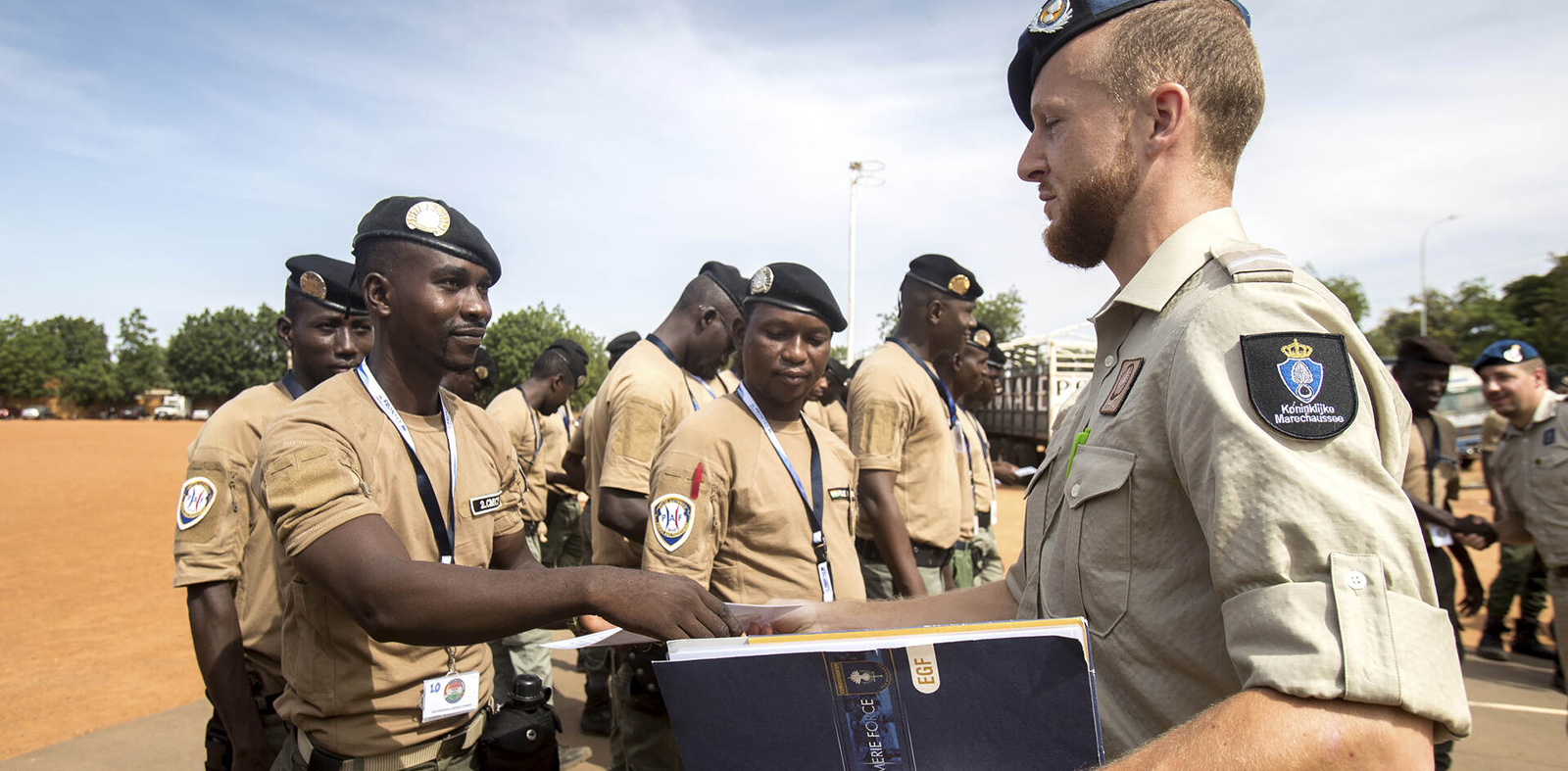
The rapid contraction of EU presence in the Sahel has sparked debate over Europe’s diminishing influence. But what did these missions get right? And what did they get wrong? EU capacity building in Sahel Niger, says Elise Ketelaars, offers important lessons for EU Common Security and Defence Policy design, and for broader security sector reform efforts
Civilian Expert, Dutch Ministry of Foreign Affairs
Elise holds a PhD in Politics and International Relations from Ulster University's Transitional Justice Institute.
Her thesis focused on EU foreign policy and human rights, and was based on extensive field research in Brussels, North Africa, and Eastern Europe.
She is an SSR professional with over five years of experience in EU and NATO external action, specialising in political analysis and advisory work at the intersection of security, international humanitarian law, and human rights.
Elise is currently seconded to NATO Mission Iraq, where she works closely with senior security sector officials on defence governance, protection of civilians, and compliance with international obligations, and contributes analytical reporting for Brussels-based decision-makers.
Previously, she served as an International Humanitarian Law and Human Rights Adviser in Iraq and as a Human Rights Adviser with EUCAP Sahel Niger, advising mission leadership on politically sensitive developments affecting EU engagement and relations with national authorities.
She has also worked in North Africa and in the Dutch Ministry of Foreign Affairs, producing analytical assessments to support EU-level policy coordination.
Elise has published widely on EU foreign policy, human rights, and transitional justice, including peer-reviewed journal articles and contributions to edited volumes.
We use necessary cookies to make our site work. We'd also like to set analytics cookies that help us make improvements by measuring how you use the site. These will be set only if you accept.
▼
Strictly Necessary Cookies
Necessary cookies enable core functionality such as security, network management, and accessibility. You may disable these by changing your browser settings, but this may affect how the website functions.
▼
Analytics Cookies
Google Analytics
We'd like to set Google Analytics cookies to help us improve our website by collecting and reporting information on how you use it. The cookies collect information in a way that does not directly identify anyone. For more information on how these cookies work please see our Privacy Notice.